Learn how to design multi-agent solutions for complex work without getting lost in hype or over-engineering.
Discover where Multi-Agent Systems fit on the automation spectrum and why they are crucial in today's evolving landscape.
Master the end-to-end design sequence and essential artefacts needed to move from ambiguity to a build-ready blueprint.
About the Quick Reference Guide
This Quick Reference Guide is designed for individuals navigating complex domains like government, finance, health, and more. It provides a clear mental model of how to design multi-agent solutions, offering just enough structure to confidently explain the approach and align stakeholders. You’ll walk away with a clear mental model of how to design multi-agent solutions for complex work—without getting lost in hype or over-engineering.
Why MASLab exists
Most organisations are still trying to solve complex work with linear tools: - workflow maps and “one true process” thinking - isolated automation efforts that don’t scale - brittle agent demos that collapse under exceptions, governance, and changing context But complex work behaves differently: - the problem is ambiguous and in flux - stakeholders compete, constraints shift - you learn as you go—and what you learn changes the pathway, the problem, and the solution Multi-agent systems (MAS) are built for this reality. With the right design, they can be non-linear, event-driven, adaptive, and coordinated around intent—not a fixed process.
MASLab Playbook
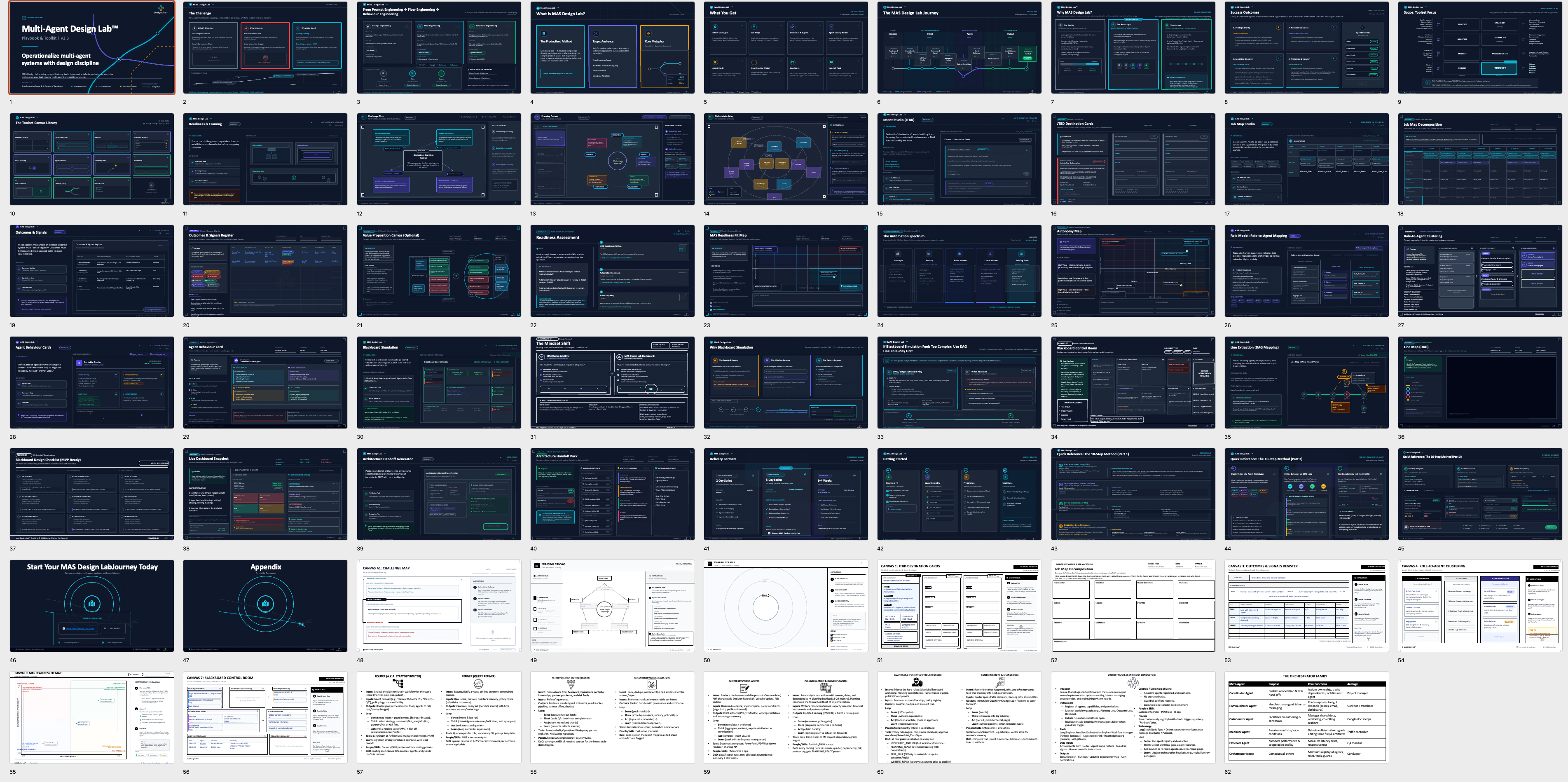
The premium MASLAB Toolkit is available for purchase and download from the attached link: https://futurebusiness.thinkific.com/products/digital_downloads/MAS-LAB The premium download includes a 60-slide, workshop-ready deck that covers the “why” and “what” of MAS, then walks you through a guided design sprint with reusable canvases and facilitation instructions. Inside the premium toolkit (high-level): - a complete MASLab sprint flow (end-to-end) - printable / reusable canvases (JTBD, job maps, outcomes & signals, role-to-agent mapping, etc.) - worked example - acilitation prompts and timing guidance - design traps to avoid when moving from linear tools to adaptive systems

Meet the Creator
I'm passionate about empowering professionals to navigate complex work domains effectively. Through my experience and expertise, I've developed this guide to help you revolutionize your approach to multi-agent systems and succeed in challenging environments.
Ready to Transform Your Approach?
Download your free copy now and revolutionize your strategy for handling complex work.
Get your free download now